
FintechZoom.com Forex Market: What It Covers, How to Use It, and What Every Trader Must Know
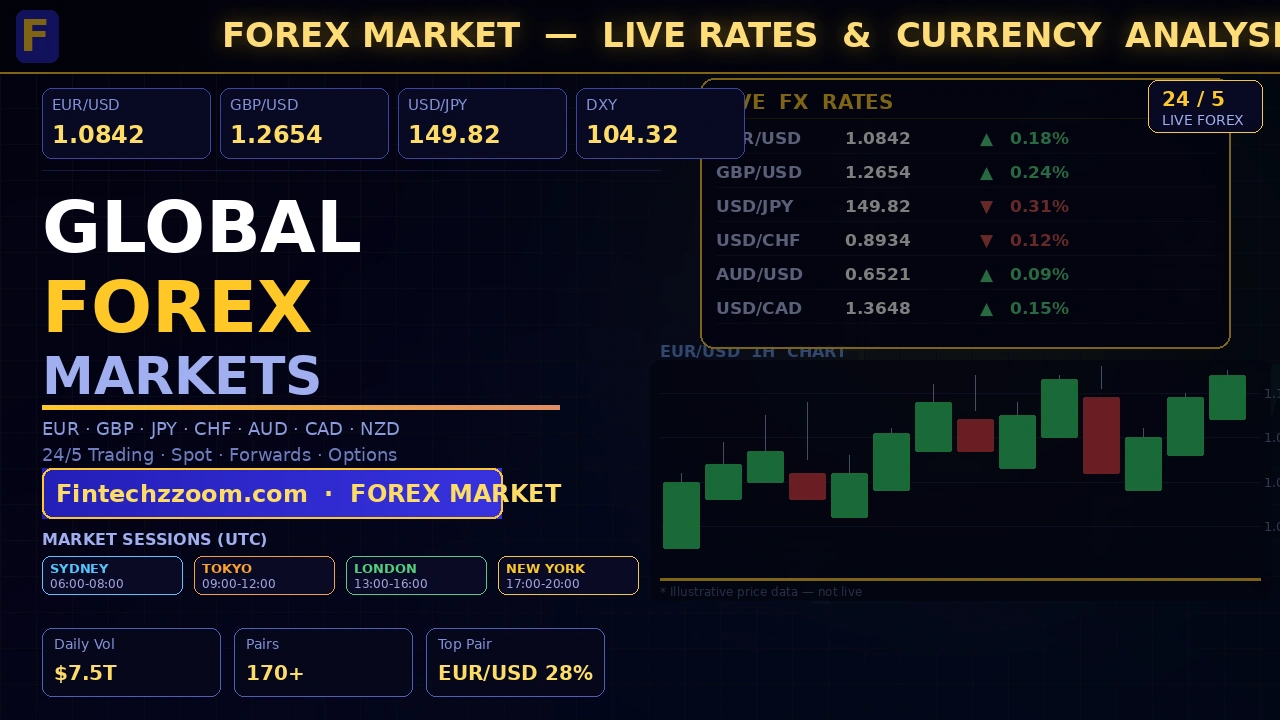
FintechZoom.com forex market refers to the dedicated currency trading section on FintechZoom.com — a global fintech news and financial data platform — that delivers live currency pair quotes, interactive charts, an economic calendar, broker reviews, signal provider comparisons, and forex market analysis for retail investors and active traders.
FintechZoom.com is not a forex broker and cannot execute trades; it is an information and analytics layer that sits between raw market data and the decisions traders make. In a market that processes $9.6 trillion in daily volume according to the Bank for International Settlements’ 2025 Triennial Survey — making it 35 times larger than the global equity market — having a reliable information source and understanding its limits are both non-negotiable.
What Is the FintechZoom.com Forex Market Section
FintechZoom.com built its platform around multi-asset financial coverage: stocks, cryptocurrency, commodities, bonds, and currencies. The forex market section is one of its most visited areas, serving users who range from retail investors tracking EUR/USD movements during Fed announcements to small business owners monitoring exchange rates that affect their import costs.
The platform’s forex coverage sits at a practical intersection. It aggregates live currency data from established financial data providers, surrounds that data with expert market commentary, and publishes educational content that explains why prices are moving rather than simply showing that they moved. That analytical layer is what separates FintechZoom from a simple exchange rate ticker — and it is what most users are actually looking for when they search for “fintechzoom.com forex market.”
Is FintechZoom a Forex Broker or a Data and Analysis Platform?
This distinction matters enormously, and most competitor articles bury it or skip it entirely.
FintechZoom.com is a data, news, and analysis platform. No currency trades can be placed through it. There is no order execution, no position management, no margin account, and no regulatory status as a broker. The platform generates and aggregates information — you take that information to a regulated forex broker to act on it.
This is not a limitation unique to FintechZoom; TradingView and Investing.com operate the same way for most users. But the distinction is critical for anyone who arrives at the platform expecting to open a trading account. You cannot. What you can do is research, track, analyze, and prepare — then execute through a CFTC-regulated broker in the US, an FCA-authorized broker in the UK, or an equivalent regulatory jurisdiction in your country.
What Currency Pairs Does FintechZoom.com Cover?
FintechZoom’s forex market section covers all major currency pairs, selected minor pairs, and periodic commentary on exotic pairs during high-volatility events. The regularly tracked pairs include:
- Major pairs (USD on one side): EUR/USD, USD/JPY, GBP/USD, USD/CHF, USD/CAD, AUD/USD, NZD/USD
- Cross pairs (no USD): EUR/JPY, EUR/GBP, GBP/JPY, EUR/CHF
- Emerging market commentary: USD/CNY, USD/INR, USD/MXN — particularly during trade policy events or central bank interventions
The platform’s daily forex market updates publish pair-by-pair analysis with current price, daily percentage change, and narrative commentary on what drove the session’s movement.
The Forex Market in 2026: $9.6 Trillion Daily and Still Growing
Context matters before you open a single FintechZoom chart. The forex market’s scale shapes everything about how it behaves — its liquidity, its accessibility, and its risks.
According to the Bank for International Settlements’ April 2025 Triennial Survey, global average daily foreign exchange turnover reached $9.6 trillion — a 28% increase from the $7.5 trillion recorded in 2022 (BIS, September 2025). That single daily figure is approximately 340 times larger than the NYSE’s daily equity volume. To put it differently: the forex market processes in one day what the global stock market processes in roughly a year. This level of liquidity is why currency spreads are measured in fractions of a cent and why large positions can be entered and exited without meaningfully moving the price.
From 2025 to 2029, the global forex market is projected to expand by a further $582 billion, with a compound annual growth rate of 10.6% expected through that period, according to Technavio market research.
Why the US Dollar Sits at the Center of 89.2% of All Trades
The most important structural fact about the forex market — and one that shapes every analysis piece on FintechZoom.com — is the US dollar’s role as the global vehicle currency.
According to the BIS 2025 Triennial Survey, the USD is present on one side of 89.2% of all currency transactions — up from 88.4% in 2022 (BIS, 2025). Since every transaction has two sides and the total adds to 200%, that means fewer than one in ten forex transactions worldwide takes place without the dollar involved.
This is not inertia or convention. It is a structural self-reinforcing loop: a Brazilian exporter paying a Thai supplier does not transact in BRL/THB — that market is too thin and too expensive. They convert Brazilian reais to US dollars, then dollars to Thai baht. The deeper the dollar market, the lower transaction costs — and the lower costs reinforce dollar usage. FintechZoom’s forex coverage reflects this architecture: its most-viewed, most-analyzed, and most-data-rich pair is EUR/USD, and virtually every major economic narrative runs through a dollar lens.
London, New York, and Singapore — When the Real Volume Happens
The forex market runs 24 hours a day, five days a week — but volume is not evenly distributed. Where and when you look at FintechZoom’s live charts significantly affects what you see.
According to the BIS 2025 data, London handles 38% of global forex turnover — the largest single geography by a substantial margin. When the IMF calculates the daily value of Special Drawing Rights and the ECB sets its EUR/USD reference rate, both use London session data because that is when the market is deepest.
New York accounts for roughly 19% of global turnover, peaking during the London-New York overlap session (approximately 8:00 AM–12:00 PM Eastern Time) — which is when EUR/USD liquidity is at its absolute highest and spreads are narrowest.
Singapore has emerged as the most important shift in forex geography over the past decade. Its share rose from 5.3% in 2010 to 11.8% of global forex turnover in 2025 — more than double (BIS 2025). This reflects China’s growing weight in global trade and the structural expansion of Asian session volume. For anyone trading USD/CNY or Asian-linked currencies on FintechZoom’s charts, the Singapore open is as important as the London open.
The practical implication: FintechZoom’s live data is most useful during active sessions. The Asian session (Tokyo/Singapore) activates around 11:00 PM GMT; London opens at 7:00 AM GMT; New York at 12:00 PM GMT. The London-New York overlap is peak liquidity. The Pacific session (post-New York, pre-Tokyo) is the quietest and least reliable for chart-based decision making.
5 Features Inside the Forex Market Section That Actually Matter
FintechZoom’s forex coverage is broader than most users realize. Here is what each feature actually delivers — and what it does not.
Live Currency Quotes and Charting Tools
The core of FintechZoom’s forex section is a live data feed covering exchange rates for all major pairs, updated continuously during trading hours. Unlike static exchange rate tables on travel or news sites, these quotes are integrated into interactive charts that allow users to view price action across multiple timeframes — from intraday hourly views to multi-year trend charts.
The charting tools support standard technical overlays including moving averages (50-day and 200-day), RSI (Relative Strength Index), MACD, and support/resistance line drawing. These tools allow users to identify trend direction, momentum, and key price levels where currencies have historically reversed.
One important caveat mirrors the gold section guidance: FintechZoom’s quotes are near-real-time rather than instantaneous. For research and trend identification, the data is fully adequate. For precision entry timing during a fast-moving news event — a Fed statement, a surprise NFP print — cross-reference with your broker’s live feed, which reflects actual bid/ask spreads in real time.
The Economic Calendar — FintechZoom’s Most Underused Tool
The economic calendar is arguably the single most useful feature on FintechZoom’s forex market section, and most users do not use it consistently.
The calendar tracks scheduled macroeconomic data releases — central bank interest rate decisions, non-farm payrolls (NFP), Consumer Price Index (CPI) reports, GDP releases, purchasing managers’ indexes (PMI), and retail sales figures — organized by release date, time, country, and expected impact level (high/medium/low). Events are tagged with the consensus forecast alongside the actual figure once released.
Why this matters: currency prices move most sharply and most predictably around scheduled events. A larger-than-expected US NFP report that signals a strong labor market will typically strengthen the dollar against all major pairs within seconds of release. A surprise dovish pivot from the ECB — even just a change in language — can move EUR/USD by 100 pips in a single session. Traders who check FintechZoom’s economic calendar before the session avoid entering positions in the wrong direction hours before a release that would wipe them out.
Broker Reviews and Signal Provider Comparisons
FintechZoom publishes evaluated reviews of regulated forex brokers covering spread competitiveness, regulatory status (FCA, CFTC, CySEC), platform quality, mobile app functionality, and minimum deposit requirements. These reviews help users vet brokers before opening a funded account — which is a meaningful service given that unregulated brokers operating from offshore jurisdictions are a genuine risk in the retail forex industry.
The platform also reviews forex signal providers — services that send trade alerts (buy EUR/USD at X, stop-loss at Y, take-profit at Z). FintechZoom’s reviews assess track record, transparency of methodology, and whether historical performance figures can be verified. Signal providers with no audited track record and no regulatory oversight are flagged as higher risk.
Forex Strategy Guides for Beginners and Active Traders
FintechZoom publishes a library of forex strategy content — from introductory guides explaining pip values and margin calculations to more advanced pieces on carry trade mechanics, breakout strategies, and how to trade currency correlations. These articles update periodically with current market examples, which keeps the content more contextually relevant than static textbook-style resources.
This educational layer is where FintechZoom most clearly distinguishes itself from a pure data provider. Knowing that EUR/USD is at 1.0850 tells you nothing useful on its own. Understanding why it is there — diverging monetary policy between the Fed and ECB, US dollar strength from still-elevated rates, euro weakness from sluggish eurozone growth — is what the editorial coverage provides.
What Actually Moves Currency Prices on FintechZoom’s Charts
Most new forex traders assume price movements are random or chart-driven. They are neither. Currency prices are constantly repricing the relative economic strength, monetary policy direction, and risk appetite of two sovereign economies. Every candle on FintechZoom’s EUR/USD chart represents the market’s real-time verdict on that comparison.
Central Bank Policy Decisions — The Biggest Single Driver
The Federal Reserve, European Central Bank, Bank of Japan, Bank of England, and Bank of Canada collectively set monetary policy for currencies that account for the vast majority of global forex turnover. When one central bank raises rates while another holds, capital flows toward the higher-yielding currency — investors move money to earn better returns, which drives demand for that currency and pushes its price up.
FintechZoom’s forex section tracks central bank communications closely because the gap between what a central bank says and what the market expected is where the biggest currency moves happen. A Fed rate hold that was 90% priced in by markets moves EUR/USD by maybe 20 pips. A surprise hawkish shift in language on a “hold” day can move it 100 pips in 60 seconds. The platform’s coverage of Fed press conferences, ECB Governing Council statements, and BoJ yield curve control policy has become some of its most read forex content.
Inflation Data, NFP Reports, and the Events That Cause 100-Pip Moves
The monthly US Non-Farm Payrolls report, released on the first Friday of each month at 8:30 AM Eastern Time, is the single most market-moving regularly scheduled forex event in the world. It measures net job creation in the US economy excluding farm workers — and because strong employment supports Fed hawkishness (higher rates, stronger dollar), the NFP release regularly moves EUR/USD, GBP/USD, and USD/JPY by 50–150 pips within the first 15 minutes.
CPI (Consumer Price Index) data releases for the US, eurozone, and UK generate comparable volatility. FintechZoom’s economic calendar flags these releases with a high-impact designation and publishes pre-release consensus forecasts so traders can track the gap between expectation and actuality — which is what matters for the price move.
Risk Sentiment: Why “Safe-Haven” Currencies Move When Nothing Else Does
Not all currency moves are driven by domestic economic data. When global risk appetite collapses — as in March 2020, during the 2022 Russia-Ukraine escalation, and during the 2026 US-Iran military conflict — traders rotate toward currencies perceived as safe havens: the Japanese yen (JPY), Swiss franc (CHF), and to a lesser extent the US dollar.
USD/JPY typically falls (dollar weakens against yen) during risk-off periods because investors unwind “carry trades” — strategies where they borrow in low-interest-rate currencies (JPY) to invest in higher-yield assets. When those higher-yield assets sell off, the carry trade unwinds and JPY demand surges. FintechZoom’s forex coverage tracks risk sentiment through equity market performance, VIX levels, and commodity price movements — the cross-asset context that explains why USD/JPY moved sharply even when no Japan-specific data was released.
Major, Minor, and Exotic Pairs — Knowing Which Column You’re Playing In
This distinction matters practically, not just theoretically, because the pair you choose determines your spread costs, data quality on FintechZoom’s charts, and how much macro reading you need to do.
| Category | Examples | USD Involvement | Liquidity | Typical Spread | Best For |
|---|---|---|---|---|---|
| Major Pairs | EUR/USD, USD/JPY, GBP/USD, USD/CHF, USD/CAD, AUD/USD | Always | Highest | 0.1–1 pip | All trader types |
| Minor/Cross Pairs | EUR/JPY, GBP/CHF, EUR/GBP, AUD/JPY | No | High | 1–3 pips | Intermediate traders |
| Exotic Pairs | USD/TRY, USD/ZAR, USD/MXN, USD/INR | Usually yes | Low–Medium | 5–50+ pips | Advanced/specialized |
The major seven pairs account for 66.3% of global forex turnover as of 2025, down from 85% in 2022 — with the gap filled primarily by the rising USD/CNY pair, which now holds 8.1% of global turnover up from near zero in 2010 (BIS Triennial Survey 2025, via compareforexbrokers.com).
FintechZoom’s most consistent, highest-quality data and commentary is concentrated on the major pairs — EUR/USD in particular, which alone represents 21.2% of global daily forex turnover (BIS 2025). If you are new to forex and using FintechZoom as your information layer, start with one or two major pairs and learn them deeply before expanding to cross pairs or exotics.
The Truth About Retail Forex Trading That FintechZoom Won’t Tell You Upfront
No honest article about the FintechZoom.com forex market section can skip this.
Between 70–80% of retail CFD (including forex) accounts lose money. This is not a warning generated by critics — it is a disclosure mandated by ESMA (the European Securities and Markets Authority) and the FCA (UK Financial Conduct Authority), required to appear on the website of every regulated broker operating in those jurisdictions. Most major regulated brokers disclose figures in the 74–81% range.
The reasons are structural, not random:
- Leverage amplifies losses as brutally as it amplifies gains. Retail forex traders typically access 30:1 leverage in the EU/UK (ESMA cap) and up to 50:1 in the US (CFTC cap). A 2% adverse price move on 50:1 leverage wipes the entire account. Most new traders underestimate how fast that happens.
- Retail traders lose to institutional counterparties. The forex market processes $9.6 trillion daily. Most of that is institutional: banks, hedge funds, central banks, and algorithmic trading desks that process price data in milliseconds. Retail traders using FintechZoom’s near-real-time data are, by definition, working with a structural information lag relative to the fastest institutional participants.
- Emotional decision-making. No data platform — including FintechZoom — corrects the behavioral errors that account for a significant portion of retail losses: holding losers too long, cutting winners too quickly, revenge trading after a loss, and overleveraging after a win.
FintechZoom’s forex section is an excellent research tool. That is exactly what it is. It does not replace a trading methodology, a risk management framework, or the emotional discipline that separates losing traders from the minority who sustain profitability. Use it as a research layer, not as a signal service to follow mechanically.
3 Forex Trading Strategies You Can Build Around FintechZoom Data
These strategies work with FintechZoom’s information layer — meaning they rely on the type of macro context and chart data the platform provides well, rather than requiring the sub-millisecond execution it cannot support.
Trend Following Using FintechZoom’s Weekly Market Analysis
Trend following is the most widely used and best-documented approach in currency markets. The strategy identifies a directional move — supported by fundamental divergence between two economies, central bank policy differences, or persistent capital flows — and holds positions in that direction through minor pullbacks.
FintechZoom’s weekly forex market analysis pieces are well-suited to supporting this approach. They identify the primary macro driver for major pairs (Fed rate expectations, eurozone economic momentum, JPY carry dynamics), which helps traders distinguish genuine trend continuation from noise. The 50-day and 200-day moving averages available on FintechZoom’s charts provide structural trend indicators: price consistently above the 200-day MA = uptrend; price below = downtrend.
Trend following requires patience and tolerance for drawdown. It is not a high-frequency strategy. Holding EUR/USD short for three to six weeks based on diverging Fed/ECB policy expectations, while managing through daily volatility, is a realistic application of this approach.
News Trading Around the Economic Calendar
News trading enters positions immediately before or immediately after high-impact economic releases — NFP, CPI, central bank decisions — and closes them within hours or even minutes.
FintechZoom’s economic calendar makes this strategy operationally accessible: check the calendar the night before, identify the high-impact releases for the next trading day, read FintechZoom’s pre-release consensus forecasts and commentary, then determine the likely market reaction scenario if the data beats or misses expectations.
News trading carries significant execution risk for retail traders. Spreads widen dramatically in the seconds around a major release as market makers pull liquidity. A position that looks profitable at the quoted pre-release spread can become a loss by the time execution fills at the actual spread. This strategy is better suited to intermediate and experienced traders who understand slippage and have tested their broker’s execution quality during high-volatility events.
Range Trading With Support and Resistance From FintechZoom Charts
When a currency pair lacks a clear directional trend — trading between two price levels rather than trending sustainably in either direction — range trading identifies those boundaries and positions for reversals.
FintechZoom’s charts allow users to identify historical support levels (where price has bounced upward multiple times) and resistance levels (where price has been rejected downward multiple times). Range traders buy near support and sell near resistance, setting stop-losses beyond the range boundaries in case of breakout.
Range trading is most reliable when FintechZoom’s economic calendar shows no major scheduled events for the duration of the trade. Unexpected news events are the most common cause of range breakouts that turn range positions into losses.
A Daily Workflow for Using FintechZoom.com Forex Market Tools Effectively
Most traders use information platforms reactively — checking prices after a move, reading analysis after a trade was triggered. This workflow inverts that pattern.
- Step 1 — Pre-session: Economic calendar review (5 minutes). Before the London open, check FintechZoom’s economic calendar for the next 24 hours. Identify all high-impact releases. Note the consensus forecast for each. Decide which pairs you will and will not trade around those releases.
- Step 2 — Chart context: Identify structure on your pairs (10 minutes). On the daily timeframe, identify the current trend direction using the 200-day moving average on FintechZoom’s chart tools. Mark visible support and resistance levels. This is your structural backdrop — everything else is noise until price approaches those levels.
- Step 3 — News context: Read FintechZoom’s daily forex analysis (5–10 minutes). The platform’s daily analysis pieces explain what drove the previous session and what the current narrative is. This is the “why” layer — it tells you whether the pair is moving on genuine macro divergence or short-term positioning.
- Step 4 — Session monitoring: Track live quotes during active hours. During the London-New York overlap (peak liquidity), monitor live quotes for your identified pairs. Compare current price to your pre-session structural levels. FintechZoom’s live data lets you watch how price behaves around key levels — whether it respects them or breaks through, which tells you something about the strength of the current move.
- Step 5 — Post-session: Review and log. After the session, read FintechZoom’s end-of-day summary if available. Compare what happened to what the pre-session calendar suggested might happen. Log what you observed. Pattern recognition built this way, over weeks and months, is more valuable than any signal service.
FintechZoom.com Forex Market vs. TradingView, Investing.com, and Forex.com: Which Fills What Gap?
No honest evaluation of FintechZoom’s forex section avoids this comparison.
| Feature | FintechZoom.com | TradingView | Investing.com | Forex.com (Broker) |
|---|---|---|---|---|
| Live currency quotes | ✅ Near-real-time | ✅ Real-time | ✅ Real-time | ✅ True real-time |
| Chart tools and overlays | ✅ Standard set | ✅✅ Industry-leading | ✅ Strong | ✅ Execution-grade |
| Economic calendar | ✅ | ✅ | ✅✅ Most detailed | ✅ |
| Market commentary/analysis | ✅✅ Strong editorial | ✅ Community-driven | ✅ Good | ✅ (broker-biased) |
| Broker/signal reviews | ✅✅ Unique strength | ❌ | ❌ | N/A (is the broker) |
| Education for beginners | ✅✅ | ✅ | ✅ | ✅ |
| Trade execution | ❌ | ❌ | ❌ | ✅ |
| AI-assisted analysis | Partial | ✅ (premium) | Partial | ✅ (premium) |
The honest summary: TradingView has superior charting tools for technically-oriented traders. Investing.com has a more comprehensive economic calendar. Forex.com (and similar regulated brokers) offer execution plus data. FintechZoom’s differentiating strength is its editorial layer — the contextual market analysis that explains why prices are moving, combined with broker reviews that help users evaluate where to execute. Use FintechZoom for market context and broker vetting; TradingView for technical chart work; your regulated broker for execution.
How AI Is Reshaping Forex Markets — and What FintechZoom Is Already Covering
FintechZoom published a detailed piece in March 2026 on AI-driven forex platforms, and the developments it describes are changing the market in ways retail traders need to understand.
According to surveys cited in that article, more than 60% of novice forex traders have adopted some form of algorithmic assistance — either for generating signals or for automated trade execution. The integration of APIs and cloud computing has democratized infrastructure that was previously available only to institutional trading desks. AI-driven platforms now execute market-making algorithms, adjust bid/ask spreads in real time based on supply/demand imbalances, and deploy predictive analytics that help brokers manage aggregate risk exposure.
For retail traders using FintechZoom’s coverage, this has two practical implications. First, the market’s information processing speed has accelerated: price moves after NFP releases happen faster than they did five years ago because more algorithmic participants react to the same data simultaneously. This compresses the window for manual news-trading strategies. Second, the signals available through AI-assisted platforms have improved in quality — though the March 2026 FintechZoom article correctly notes that even AI models with 70%+ controlled-setting accuracy can fail in live markets when confronted with low-liquidity events or genuine geopolitical surprises.
The broader trajectory is clear: AI will not eliminate the need for market understanding, but it is raising the competency floor. Retail traders who use FintechZoom’s educational and analytical coverage to develop genuine market understanding will be better equipped to work alongside — rather than against — algorithmic participants.
Who Should Use FintechZoom.com for Forex — and Who Needs More Than This
FintechZoom.com forex market is well-suited for:
- Beginners who want to understand how currencies move, what economic events drive them, and which brokers to trust before opening a funded account
- Intermediate traders who need daily market analysis and economic calendar context to supplement their chart work
- Long-term investors monitoring currency exposure in international portfolios — understanding why EUR/USD is moving helps evaluate FX risk in European equity holdings
- Researchers and students who need accessible, editorial-grade coverage of global currency markets with real data
- Business owners tracking exchange rates for import/export cost planning
You need additional tools or platforms if:
- You require sub-second execution-grade data for scalping or algorithmic strategies — FintechZoom’s near-real-time data is not built for this
- You want institutional-depth charting with 50+ indicators, community-published scripts, and professional-grade tools — TradingView is the appropriate platform
- You need to actually execute currency trades — you need a regulated broker account, full stop
- You need the most comprehensive economic calendar in the market — Investing.com’s calendar offers more granular detail and earlier release scheduling
- You are considering offshore or unregulated brokers — FintechZoom’s broker review section is designed to steer you away from these, not toward them
The honest framing: FintechZoom.com is a strong first and second screen for retail forex participants. It is most valuable as the layer that tells you what is happening and why — which is foundational knowledge that no trader can skip. It is not the screen you look at when you are about to click “buy” or “sell.” Your regulated broker’s platform is where that happens, informed by the understanding you built on FintechZoom.
FAQs
Can I actually trade forex through FintechZoom.com?
No. FintechZoom.com is a financial news, market data, and analysis platform—not a regulated forex broker. It does not allow users to execute currency trades. To trade forex, you must open an account with a licensed broker regulated by authorities such as the CFTC (U.S.), FCA (U.K.), CySEC (Europe), or the appropriate regulator in your country. FintechZoom’s broker reviews can help you compare regulated trading platforms.
How often does FintechZoom update its currency price data?
FintechZoom updates forex price data continuously while the global forex market is open. Since currency markets operate 24 hours a day from Sunday evening (Sydney session) through Friday afternoon (New York session), exchange rates are refreshed throughout the trading week. Outside market hours, the platform displays the last available price along with its most recent update time.
Which forex pairs get the most coverage on FintechZoom?
EUR/USD receives the most comprehensive coverage, including daily forecasts, intraday analysis, and market commentary. Other major pairs such as USD/JPY, GBP/USD, and USD/CHF are also updated frequently. Cross-currency pairs like EUR/JPY and GBP/JPY receive additional attention during major Bank of Japan or European Central Bank events, while exotic currency pairs are generally covered only when significant economic or political developments occur.
Does FintechZoom.com have a mobile app for tracking forex?
FintechZoom.com is fully optimized for mobile browsers, allowing users to monitor live forex prices, read market analysis, and access the economic calendar from smartphones and tablets. Whether a dedicated mobile app is currently available should be confirmed through the official FintechZoom website, as app availability may change over time. Traders who require instant push notifications often rely on regulated broker apps for more advanced alert features.
What is a pip, and why does it matter for reading FintechZoom forex data?
A pip (percentage in point) is the standard unit used to measure movements in currency prices. For most major currency pairs, one pip equals 0.0001 (the fourth decimal place). For example, if EUR/USD rises from 1.0850 to 1.0900, it has moved 50 pips. Currency pairs involving the Japanese yen are quoted differently, where one pip equals 0.01. Understanding pips helps traders accurately measure market volatility, profits, losses, and risk.
How do I use the FintechZoom economic calendar before a major release?
Open the economic calendar before your planned trading session and filter events by the currencies you’re trading and by “High Impact” announcements. Review the scheduled release time, the previous reading, and the market consensus forecast. If the actual result exceeds expectations, the associated currency often strengthens; if it falls below expectations, the currency may weaken. However, market reactions depend on how the data compares with what traders had already priced into the market.
Is forex trading legal in Pakistan, India, and other non-US/UK markets?
Forex trading regulations differ by country. In Pakistan, trading through overseas forex brokers exists in a regulatory gray area because foreign exchange transactions are subject to restrictions imposed by the State Bank of Pakistan, and most international brokers are not locally licensed. In India, forex trading is permitted through SEBI-regulated exchanges for approved INR-based currency pairs, while trading many offshore currency pairs through foreign brokers is restricted. Always verify the latest regulations in your jurisdiction before opening a trading account.
What leverage is typical in forex, and what risks does it carry?
Leverage allows traders to control positions much larger than their account balance. Retail leverage is capped at 30:1 in the UK and European Union under ESMA rules and 50:1 in the United States under CFTC regulations. Some offshore brokers advertise leverage of 100:1 or higher, but greater leverage increases both potential profits and potential losses. At 30:1 leverage, a market move of about 3.3% against your position can wipe out your trading capital, while at 50:1 leverage, only a 2% adverse move can have the same effect. Effective risk management, position sizing, and disciplined stop-loss use are essential for long-term trading success.
